Wednesday, 29 August 2012

Walter Sickert


http://roymunday.com/website2/site2/sickert.1.jpg 


La Giuseppina  

 
 Self-Portrait

Links To Helpful Bits of The Internet

Stuff on Sickert:
Tate resource with images, BBC resource with loads of images

John Singer-Sargent:
Metropolitan Museum (largest JSS collection anywhere) masses and masses of images, loads of sketches

Degas:

Met Museum thematic essay

Munch:
Guardian article on Tate Munch exhibition

Rounding Up Influences Thus Far: Impressionism/Expressionism

I would like to collect together the various threads of thought pertaining to my project entitled 'Youth, Beauty, Ageing and Vanity' contained in this blog into a single, more coherent and practical definition of the direction the project will take. Starting from a completely blank position, the artists which have struck me as exciting and relatable to my own intentions as an artist seem to be connected in some way to the Impressionism movement. However, I am taking selectively from this collective of ideas and techniques, and in conjunction with a number of other schools of thought.

Rather than being drawn to the classic interpretation of Impressionism, such as Monet's vibrant landscapes, I have rather found inspiration in Degas' own, uniquely 'un-impressionist' form of Impressionism, with his careful, muted colour palette, slow and precise way of working in a studio and yet retention of the vibrancy, dynamism and looseness of technique which is more prevalent in the works of Monet or Renoir. His series on ballerinas and women bathing are particularly interesting, not only from a technical viewpoint in the delicate and intense way he handles the pastel colours and defined lines, but from a thematic point they also capture a sense of beauty, age, and the connection between the mind and the body which is the underpinning concept of my title.

However from the very origins of my project, Edvard Munch has been influential on my ideas. Although often considered a 'pure-breed' Expressionist, Munch is in fact difficult to define in relation to any particular artistic movement, as throughout his career he experimented with many different styles, including Impressionism. However, whilst Impressionism is often about capturing a personal interpretation of an external scene, Munch's Expressionist works were about interpreting the internal ideas and emotions of the artist, and his paintings have an almost diarylike quality. However, the things in common between Much and the Impressionist artists I am inspired by such as Degas, Sickert and Vuillard (the latter being more of a post-impressionist but whatever) are the emotional and physical narrative they offer. A combination of the beauty and life-imbued studies of the phyical state and sense of atmosphere offered by the Impressionist work and Munch's harrowing emotional symbolism are the key components of this project which I wish to be a study into both the emtional and physical relationship between youth and growing old (physical) with the concepts of beauty and vanity (emotional/internal)

And then of course there is my old favourite, John Singer-Sargent, thrown in for good measure and to complicate things further. From this clever old man I wish to take his watercolour and drawing technique with which he re-invented himself with in later life and which is explored in a previous post.

This is a rather haphazard, over-punctuated, disorganised attempt to make sense of a sprawling web of somewhat directionless ideas, but it's my best shot as of yet.

Saturday, 18 August 2012

Such a Lot to Learn


The versatility of the nude, the beauty of flesh, the cold sexless cynicism of modern art, the tactless bullying of a feminist interpretation of art, the misinterpretation of the Victorians and a misguided attribution of sexual understanding to the artwork of today. In forty-five minutes. With the exception of his reverence for the ideological value of the Victorian persuasion for 'fairy painting' I strongly concurr with the opinions expressed by Mr. Howard Jacobson in this film.

Friday, 13 July 2012

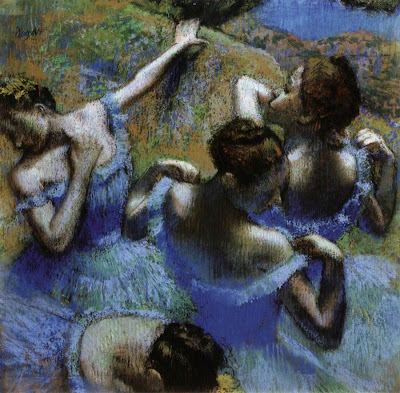
Pastel Work - Degas

https://blogger.googleusercontent.com/img/b/R29vZ2xl/AVvXsEh4Ny5nSoOYXhHi1T29pKN8wAmM_nC12kKwI22Cuowy7sT81u4_s9qSoDtVp6l9N-cL9xTqZupxDbDSbr5HImmSDuRR_vbfxz0bkLUfq8P-wQkHPrhxuDiWRHgsHp006uYwoV56KR1I19wA/s1600/Blue%20Dancers%20(Les%20Danseuses%20Bleues),%201890.jpg


Dancers In Blue - Edgar Degas

http://foxpudding.files.wordpress.com/2011/05/edgar_germain_hilaire_degas_032.jpg
Woman in the Bathtub - Edgar Degas (1886) - Pastel on Paper

The delicacy and evocative texture of chalk pastel work (particularly that of the master pastelist, Edgar Degas) is something which I would like to use in this project, as if it is an impressionistic style which I wish to explore and develop, this is one of the key mediums of the original movement and the natural qualities of pastels seem to capture the sense of light and movement, as well as the vague interprative element which defined impressionism. Thus far, I have designated oils, chalks and watercolours as potential media to use in this forthcoming project.

http://www.metmuseum.org/toah/hd/dgsp/hd_dgsp.htm

Wednesday, 11 July 2012

Singer Sargent and Impressionism


"Can a bold dash of blue, amid a fog of greys and a few delicate flecks of black really justify itself as a portrait ? Isn’t an impressionist portrait then an oxymoron in itself ? On the other hand, our memories of people aren’t crisp black and white either. People are a mere sum of impressions in the memories of other people."
- Anonymous Author of 'Dotted Frontiers'
Portraits painted in the Impressionist style - a fine example of which is the above work by John Singer Sargent entitled 'Ena Wertheimer With Antonio Mancini' - aimed to capture not a likeness of the image of a person, but the emotion impression that they created. The above work is marvellous for its economy of technique, the seemingly spontaneous and lazy brushstrokes are in fact meticulously considered, with every blob and dash of colour serving a definite purpose to create the overall image. The bright explosion of colour behind the two figures represent the vibrant, brilliant impression Wertheimer and Mancini left on Sargent and his high esteem for them - both practising artists themselves.

http://uploads1.wikipaintings.org/images/john-singer-sargent/the-green-dress-1912.jpg

The above work 'The Green Dress' by Sargent shows how with just a very limited number of brushstrokes, a remarkable likeness can be achieved. The success of this portrait as a likeness lies in Sargent's choice of features to pick out: the angle of the brows, the closed eyelids, the firm set lips and sharply angle nose and cheekbones all create the strong emotional impression that Wertheimer is, in this portrait, attempting to read peacefully but is restless and frustrated at being trapped inside (these studies were painted when Sargent, Wertheimer and Mancini were holidaying together in Venice, and this particular painting on a day when the party were forced to remain indoors due to poor weather).


Peter Harrison - John Singer Sargent

I absolutely love these portraits, they are in my opinion the perfect way to capture a personality and an amalgamation of memories, and are truly beautiful as pieces of art. I think that the bold, spontaneous yet considered use of watercolours is something that I will include in my exploration of the title 'Aging, Youth, Beauty and Vanity'. Impressionist portraits are often of friends or family of the artists as mainstream commissions for this avante-garde and rebellious style were few. This gives the portraits a personal, emotive character which suits my plan to use friends and family as subjects, as it was a primary concern of mine that by using people close to me as subjects I would somehow have to disguise this relationship to express more clearly the overarching themes of death/narcissism that will undoubtedly stem from my title. However this technique gives me a way of incorporating personal relationships into the very fabric of the paintings, something which I feel when explored in conjunction with the greater themes of the project will produce some highly interesting results.

In short, it seems that this style of painting suits well the ideas I wish to explore, my own tendencies and intentions as an artist, and the kind of subjects I will be working with. Rather than declaring 'I will now produce some work in the Impressionist style' I am saying instead that this seems to be the legitimate art movement closest to the ideas I wish to express and my own idea of how art should look.

http://dottedfrontiers.com/art/2010/09/impressionist-portraits-oxymorons-by-john-singer-sargent/

Monday, 9 July 2012

A Goldmine of Images

degas self portrait new

Self-Portrait, c.1857-58 by Edgar Degas. Photograph: © Sterling and Francine Clark Art Institute, Williamstown, Massachusetts


http://www.guardian.co.uk/artanddesign/2012/jul/08/paris-impressionism-paintings-clark-review

This article, singing the praises of American art collector Sterling Clark, contains many links to works by Degas, Manet and Monet, whose impressionistic styles I find enticing and interesting. The aptly named Sterling was obviously a man of more taste than money, which is impressive considering he was the heir to the Singer sewing machine fortune and owned an entire block of Manhatten before he was twenty...